

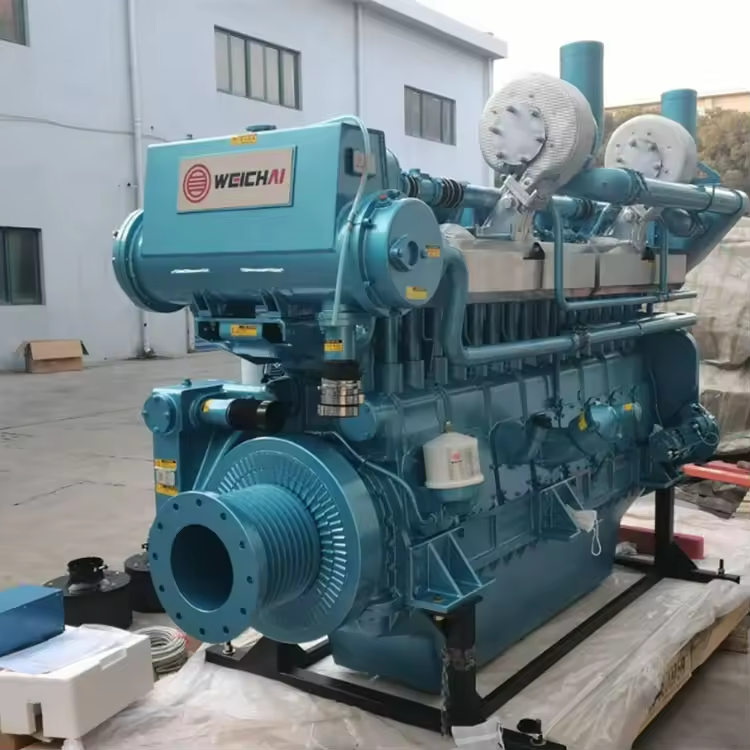
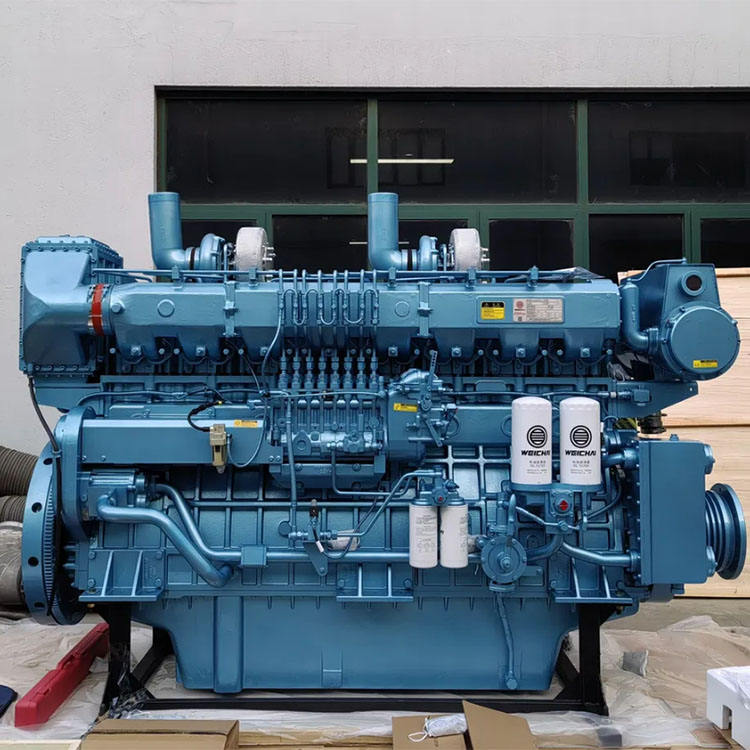
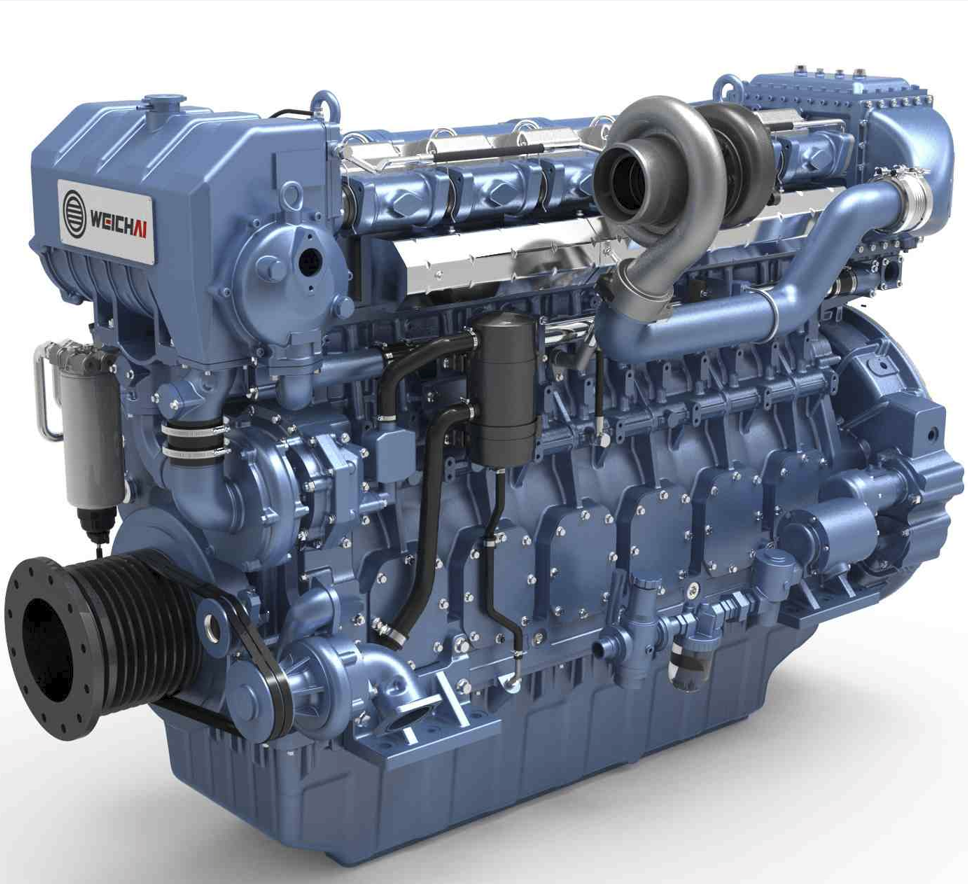
Parameter
Type | Four-stroke, water cooled, in-line, turbocharged and aftercooled | Number of cylinders | 8 |
Bore & stroke | 170×200 (mm) | Displacement | 36.32 L |
Oil consumption rate | ≤0.5 g/kW.h | Noise | ≤105 dB(A) |
Minimum fuel consumption rate | 197 g/kW.h | Idle speed | 450-650 r/min |
Torque reserve | 20-34% | Rotation (facing the flywheel) | Counter-clockwise |
Dimensions L×W×H) / net weight | 2650×1040×1818 (mm) / 3800kg | ||
Series | Model | Aspiration | Rated power kW/HP | Speed r/min | Fuel system | Emission | Power rating |
8170 | 8170ZC600-1 | TA | 441/600 | 1000 | Mechanical pump | IMO Ⅱ | P1 |
8170ZC720-2 | TA | 530/720 | 1200 | Mechanical pump | IMO Ⅱ | P1 | |
8170ZC818-3 | TA | 601/818 | 1350 | Mechanical pump | IMO Ⅱ | P1 | |
8170ZC900-3 | TA | 661/900 | 1350 | Mechanical pump | IMO Ⅱ | P1 | |
8170ZC900-5 | TA | 661/900 | 15000 | Mechanical pump | IMO Ⅱ | P1 | |
8170ZC1000-5 | TA | 735/1000 | 1500 | Mechanical pump | IMO Ⅱ | P1 |
Product Features
STRONG POWER AND EFFICIENT OUTPUT
High power density and torque reserve: Diesel engines are the mainstream models with stable torque output, suitable for different speed requirements such as ocean-going cargo ships and high-speed warships. The design can meet the 24-hour continuous full-load operation, with a major overhaul cycle of up to 20,000 to 30,000 hours, making it suitable for long-distance ocean shipping operations.
FUEL ADAPTABILITY
Low fuel consumption rate: The thermal efficiency of diesel engines can reach 40%-55%, and the fuel consumption rate of low-speed engines is as low as 160g/kWh, which is more economical than gas turbines. Flexible fuel adaptation: It can be customized to adapt to heawy oil, diesel, LNG, methanol, and other fuels, reducing operating costs while meeting the demands of energy transition.
ENVIRONMENTAL ADAPTABILITY
The shell is made of a corrosion-resistant alloy, and the key components have undergone moisture-proof and salt spray protection treatment, adapting to the high-humidity and high-salt environment of the ocean. Customizable low-temperature start system and high-temperature heat dissipation enhancement device to meet the navigation requirements in extreme sea areas such as polar and tropical regions.
TECHNOLOGICAL INNOVATION
Digital monitoring system: Integrating sensors and doud management platform, it monitors parameters such as pressure and temperature in real time, and supports fault early warning and energy consumption analysis. Hybrid power integration: The diesel-electric hybrid system can be driven by electricity at low speeds, reducing emissions and recovering braking energy. thereby improving energy utilization efficiency.


