
1. Background
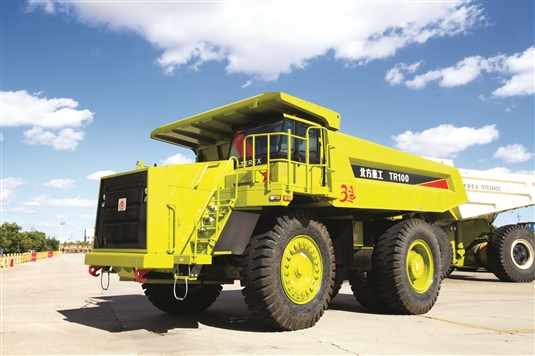
Inner Mongolia North Heavy Industries Group (NHI / NHL, 北方重工) developed the TR100A as the upgraded successor to its earlier TR100 rigid mining dump truck — a 91-tonne-payload, 180-tonne-GVW hauler designed for open-pit mining and large-scale earthmoving. The predecessor TR100 was powered by the Cummins KTA38-C: a 37.7 L, V12, mechanically governed diesel rated 783 kW (1,050 HP) @ 2100 rpm. While proven and durable, the KTA38-C carried inherent limitations for next-generation fleet requirements:
- Mechanical fuel system — the PT injection system lacked full-authority electronic control, limiting precision in fuel delivery, diagnostics, and emissions management;
- Larger displacement — 37.7 L meant higher baseline fuel consumption and a heavier, bulkier engine package;
- Emissions gap — the legacy engine’s combustion did not meet contemporary non-road emission standards increasingly required by mining regulators;
- Limited telematics integration — modern mine fleet-management and autonomous-driving systems require rich, real-time engine data over standard communication protocols (J1939);
- Future-proofing — NHI’s roadmap included an autonomous variant (NTR100A), demanding an engine platform with robust electronic control and communication capability.
The engineering challenge: find a power plant that delivers the same 783 kW @ 2100 rpm to preserve the proven drivetrain and haulage performance, while modernizing fuel system, emissions, diagnostics, and telematics readiness — all within a package that fits the existing truck architecture.
2. Solution: Cummins QST30-C1050 as Standard Power
NHI selected the Cummins QST30-C1050 as the standard engine for the TR100A platform — a decision validated by the engine’s proven pairing with the same Allison 8610 ORS transmission already used in the TR100.
The QST30-C1050 delivers identical rated power and speed (783 kW / 1,050 HP @ 2100 rpm) to the previous KTA38-C, in the same V12 configuration. It pairs with the Allison 8610 ORS (H8610AR CEC2) — the same transmission family already proven in the TR100 — so the drivetrain interface requires no redesign. Yet beneath this compatibility, the QST30 is a fundamentally more advanced engine: 19% smaller displacement (30.5 L vs. 37.7 L), Bosch full-authority electronic fuel injection, EPA Tier 2 certification, J1939 telematics, and approximately 700 kg lighter. This combination of plug-compatible power with a modernized core made it the ideal engine for the platform upgrade.
QST30-C1050 Key Specifications
| Configuration | 12-cylinder, V-type, 4-stroke, water-cooled diesel |
| Displacement | 30.5 L (1,861 in³) |
| Bore × Stroke | 140 × 165 mm (5.51 × 6.49 in) |
| Rated Power | 783 kW (1,050 HP) @ 2100 rpm |
| Peak Torque | 4,629 N·m (3,415 lb·ft) @ 1300 rpm |
| Aspiration | Turbocharged & aftercooled |
| Fuel System | Bosch high-pressure electronic system, full-authority ECM |
| Compression Ratio | 15.7:1 |
| Emissions Level | US EPA Tier 2 |
| Fuel Consumption @ Rated | 218 g/kW·h @ 2100 rpm |
| Cold-Start Capability | −12 °C without auxiliary systems |
| Net Weight (with flywheel & alternator) | ~3,328 kg |
| Overall Dimensions | 1,855 × 1,327 × 1,647 mm |
| Manufacturing | Chongqing Cummins Engine Co. (CCEC) |
TR100 vs. TR100A Engine Comparison
| Parameter | TR100 (KTA38-C) | TR100A (QST30-C1050) |
|---|---|---|
| Configuration | V12, 4-stroke diesel | V12, 4-stroke diesel (same layout) |
| Displacement | 37.7 L | 30.5 L (−19%) |
| Rated Power / Speed | 783 kW @ 2100 rpm | 783 kW @ 2100 rpm (identical) |
| Peak Torque | ~4,700 N·m class @ 1300–1400 rpm | 4,629 N·m @ 1300 rpm |
| Fuel System | Mechanical PT injection | Bosch electronic, full-authority ECM |
| Control & Diagnostics | Minimal instrumentation | Full-authority ECM, J1939, real-time diagnostics |
| Emissions | Legacy (pre-Tier / Tier 1 era) | US EPA Tier 2 |
| Transmission | Allison H8610AR CEC2 | Allison 8610 ORS (same family) |
| GVW | 160 t | 180 t (upgraded frame & suspension) |
3. Integration & Validation Process
- Platform engineering — NHI engineers integrated the QST30-C1050 into the TR100A chassis, leveraging its more compact envelope (1,855 mm length) and ~700 kg weight saving to optimize weight distribution and rear-bay service access.
- Drivetrain matching — Coupled to the Allison 8610 ORS via standard SAE flywheel housing; the Allison CEC2 electronic control was calibrated to the QST30’s torque curve (4,629 N·m @ 1300 rpm) for optimal shift points and retarder performance.
- Cooling system — Matched the charge-air cooler and radiator to the QST30’s heat-rejection profile; heavy-duty dual-stage air cleaners with safety elements fitted for high-dust mining environments.
- Fuel system — Installed Bosch high-pressure fuel lines and water-separating filtration to protect the electronic injection system; 1,275 L fuel tank retained.
- Electrical & telematics — Integrated the QST30’s full-authority ECM with the truck’s CBCU (body controller) via J1939, feeding engine speed, temperatures, oil pressure, fault codes, and fuel data to the operator display and mine fleet-management system.
- Autonomous readiness — The J1939 interface and Allison’s 5th-generation electronic controls enabled seamless integration with NHI’s autonomous driving controller on the NTR100A variant, including virtual gear selection and safety interlocks (e.g., body-raised reverse inhibit).
- Field validation — Prototypes underwent loaded ramp-climb testing, descent-with-retarder trials, and extended-cycle durability runs at customer mine sites; confirmed stable exhaust temperatures, smooth shifting, and fuel economy gains before series production.
4. Field Results
- Proven power, modernized core — same 783 kW @ 2100 rpm as the predecessor, but with Bosch full-authority electronic fuel injection replacing mechanical PT injection for precise combustion control;
- Improved fuel economy — the 30.5 L platform with electronic injection delivers lower liters-per-tonne-kilometer than the 37.7 L mechanical engine (representative figures subject to site calibration);
- Cleaner operation — EPA Tier 2 combustion reduces visible smoke and particulate, meeting tightening non-road emission requirements at mining sites;
- Smart diagnostics — J1939-linked ECM provides real-time engine data to the operator display and fleet-management telematics, turning maintenance from reactive to predictive;
- Autonomous-ready — the electronic engine and Allison 8610 ORS electronic controls enabled NHI to develop the NTR100A autonomous variant; 20 units have been delivered to Conch Cement (海螺水泥) for driverless mine haulage;
- Parts & service advantage — QST30 is manufactured by Chongqing Cummins (CCEC) with comprehensive domestic parts supply and technical support, reducing lead times versus imported alternatives;
- Higher GVW capability — the TR100A platform upgraded to 180 t GVW (from 160 t), with the lighter engine contributing to structural margin for the increased gross weight.
5. Technical Highlights
- Identical power rating (783 kW @ 2100 rpm) in a 19% smaller package — higher specific output without sacrificing proven haulage performance;
- V12 architecture retained — same cylinder count and layout as the KTA38-C, preserving engine-bay geometry and service familiarity for fleets transitioning from TR100 to TR100A;
- Bosch full-authority electronic fuel system — precise multi-injection control balancing power, fuel economy, and Tier 2 emissions;
- Factory-proven Allison 8610 ORS pairing — the same engine-transmission combination is also standard on the SANY SRT95C, validating the drivetrain match across multiple OEM platforms;
- J1939 telematics & autonomous readiness — full electronic integration enabling fleet management and NHI’s NTR100A autonomous driving system;
- Heavy-duty mining design — engineered for high load factors and 24/7 duty cycles; CPAK industrial configurations rated for 50 °C ambient cooling capability;
- CCEC domestic manufacturing — built by Chongqing Cummins Engine Co., ensuring parts availability and service support across China’s mining regions.
6. Conclusion
The integration of the Cummins QST30-C1050 into the NHI TR100A represents a textbook example of platform evolution done right: by selecting an engine that delivers identical rated power and speed to the predecessor KTA38-C — in the same V12 architecture and paired with the same Allison transmission family — NHI modernized the truck’s fuel system, emissions, diagnostics, and telematics without disrupting the proven drivetrain. The result is a hauler that hauls just as hard, burns less fuel, runs cleaner, talks to fleet systems, and is ready for autonomous operation. The subsequent deployment of 20 NTR100A autonomous trucks at Conch Cement demonstrates that this engine-platform pairing was not merely a specification upgrade but an enabler of NHI’s next-generation mining strategy. The QST30-C1050 × TR100A stands as a validated reference for engine selection in the 90–100-tonne rigid hauler class.