
1. Background
In the 100-tonne-plus mining excavator class, the engine is the single component that decides whether a loading tool keeps pace with the haul fleet. Duty cycles are brutal: sustained full-throttle digging on the muck pile, repeated peak hydraulic loads at the breakout point, high ambient temperatures and dust, and operating windows that stretch across multiple shifts.
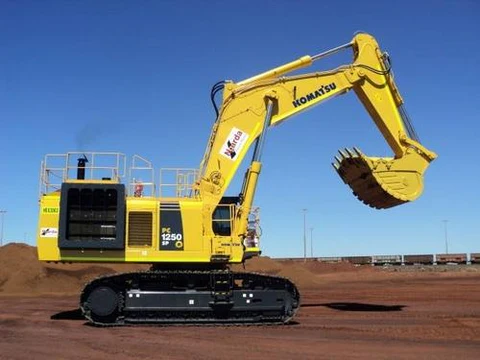
When Komatsu developed the PC1250-8 to succeed the PC1250-7, the company set three priorities for the power unit:
- Reliable gross output around 700 PS to drive the enlarged 3.4–8.3 m³ bucket range and the twin 2 × 494 L/min main pumps;
- Emissions compliance without added operator burden — meeting stricter exhaust regulations without diesel particulate filter (DPF) regeneration downtime or selective catalytic reduction (SCR) consumables;
- Low total operating cost — extended oil and filter intervals, onboard machine management, and a proven long-block architecture already field-proven in Komatsu mining machines.
Komatsu answered with its own engine: the SAA6D170E-5 — the factory-standard power unit of the PC1250-8.
2. Solution: The SAA6D170E-5 Power Unit
The SAA6D170E-5 is a 23.15-litre inline-six purpose-matched to the PC1250-8’s hydraulic and cooling systems. Its cooled-exhaust-gas-recirculation (cooled EGR) strategy was central to the design: by recirculating and cooling exhaust gas to lower combustion temperatures, NOx output is controlled inside the cylinder — no DPF, no SCR, no urea dosing, and no regeneration pauses during production digging.
Engine Key Specifications
| Parameter | Specification |
|---|---|
| Engine Model | Komatsu SAA6D170E-5 |
| Type | 4-cycle, water-cooled, direct injection diesel |
| Aspiration | Turbocharged, aftercooled |
| Emissions Strategy | Cooled EGR (no DPF / no SCR / no DEF) |
| Cylinders | 6, inline |
| Bore × Stroke | 170 × 170 mm |
| Displacement | 23.15 L |
| Gross Power (ISO 14396 / SAE J1995) | 514 kW (699 PS / 688 HP) @ 1800 rpm |
| Net Power (ISO 9249 / SAE J1349) | 502 kW (683 PS / 673 HP) @ 1800 rpm |
| Net Power at Max Fan Speed | 463 kW (approx. 620 HP) |
| Governor | All-speed, electronic |
| Fan Drive | Hydraulic (speed on demand) |
Engine-to-Machine Matching
| PC1250-8 Parameter | Value | Engine Contribution |
|---|---|---|
| Operating Weight | 106,500 kg | — |
| Bucket Capacity Range | 3.4–8.3 m³ | 514 kW gross output sustains breakout and full-arm cycle at rated payload |
| Main Pump Flow | 2 × 494 L/min (implement & travel) + 600 L/min swing | Electronic all-speed governor holds 1800 rpm under pump switchover loads |
| Working / Travel / Swing Pressure | 31.4 / 34.3 / 27.5 MPa | Torque reserve absorbs peak-pressure digging events without rpm sag |
| Bucket / Arm Digging Force | 48,800 / 42,000 kgf | Direct-injection turbo + aftercooling keeps cylinder charge dense at full load |
| Coolant / Engine Oil / Fuel Tank | 142 L / 86 L / 1,360 L | Hydraulic fan drive matches cooling to load, minimizing parasitic loss |
3. Integration & Validation
Because the SAA6D170E-5 was developed in-house alongside the machine, engine and excavator were engineered as one system:
- Hydraulic matching: pump torque demand curves mapped to the engine’s torque band so boom-arm-bucket priority valve transitions do not stall the engine during compounded digging cycles.
- Cooling system design: hydraulic fan drive sized for 142 L coolant circuit, with fan speed controlled by load — full airflow at peak dig, reduced parasitic power at light load.
- Electronic integration: the engine’s electronic governor tied into the PC1250-8’s Equipment Management Monitoring System (EMMS) for fault codes, trending and early-warning diagnostics in the cab.
- Mode mapping: two selectable working modes (Economy / Power) calibrated in the controller to trade fuel burn against digging speed at the operator’s choice.
- Durability testing: reinforced boom and arm structures, vibration-isolated electronics, and hardened electrical components validated alongside the engine in mine-site duty testing before release.
- Serviceability layout: ground-level access to filters, with oil, oil-filter and hydraulic-filter change periods extended versus the PC1250-7, and large platforms/walkways for safe routine maintenance.
4. Field Results
Across mine and quarry loading fleets, the PC1250-8 with the SAA6D170E-5 earned a reputation for:
- High availability — no aftertreatment consumables or regeneration downtime to schedule around;
- Strong cycle productivity — 48,800 kgf bucket force and fast arm cycles matched to 90–100-tonne haul trucks such as the HD785 class;
- Predictable operating cost — extended service intervals, EMMS-driven condition monitoring, and a 23.15 L long-block architecture shared across Komatsu’s large-machine engine family for parts commonality;
- Operator environment — hydraulic fan drive reduces noise; vibration-isolated electronics improve reliability of the monitoring stack.
5. Technical Highlights
- Cooled EGR — compliance without hardware overhead: NOx is controlled at the source via cooled exhaust gas recirculation, eliminating DPF, SCR and urea infrastructure entirely — a decisive advantage in remote mines where DEF supply chains are weak.
- Square 170 × 170 mm architecture: the 23.15 L square-bore/stroke inline-six balances low-end torque against piston speed, giving a broad usable band under 31.4 MPa working pressure.
- Electronic all-speed governor: precise rpm control under fluctuating hydraulic loads — the foundation of the machine’s two-mode productivity/fuel strategy.
- Hydraulic fan drive: cooling matched to demand rather than engine speed, reclaiming power at partial load and reducing noise in the cab.
- In-house engine–machine co-engineering: as a Komatsu engine in a Komatsu excavator, every calibration — from pump torque control to EMMS diagnostics — was validated as a single system rather than integrated across supplier boundaries.
- Family continuity: the 6D170 platform evolved through E-3, E-5 and later E-7 (PC1250-11) versions, preserving core architecture, tooling and service knowledge across generations.
6. Conclusion
The PC1250-8’s pairing with the Komatsu SAA6D170E-5 is a textbook case of purpose-built OEM power matching. By developing the 23.15 L cooled-EGR engine in-house and engineering it as one system with the excavator’s hydraulics, cooling and electronics, Komatsu delivered a 106-tonne mining loader with 699 PS of dependable output, no aftertreatment consumables, extended service intervals and strong fleet availability. The PC1250-8 remained a mainstay of mine loading fleets worldwide, and the 6D170 engine family carried the platform forward into the Tier-4-Final PC1250-11 generation.