
Two machines, two answers.
A Komatsu PC1250-8 left the factory with a SAA6D170E-5 — 23.15 litres, inline-six, 170 mm bore and stroke, 514 kW gross at 1800 rpm. Komatsu designed that engine and that excavator as one piece: pump torque curves, hydraulic fan drive, the EMMS onboard monitoring system and two calibrated working modes all validated together.
A Komatsu PC1200 in the field has a second option the PC1250 does not: a Cummins QSK23-C760 repower, which displaces the same 23.15 L with the same 170 × 170 mm geometry and picks up your existing main pump through an SAE 0×18 flywheel housing.
Most articles on this topic pick one path and argue for it. This one does not, because the decision is not really about engines.
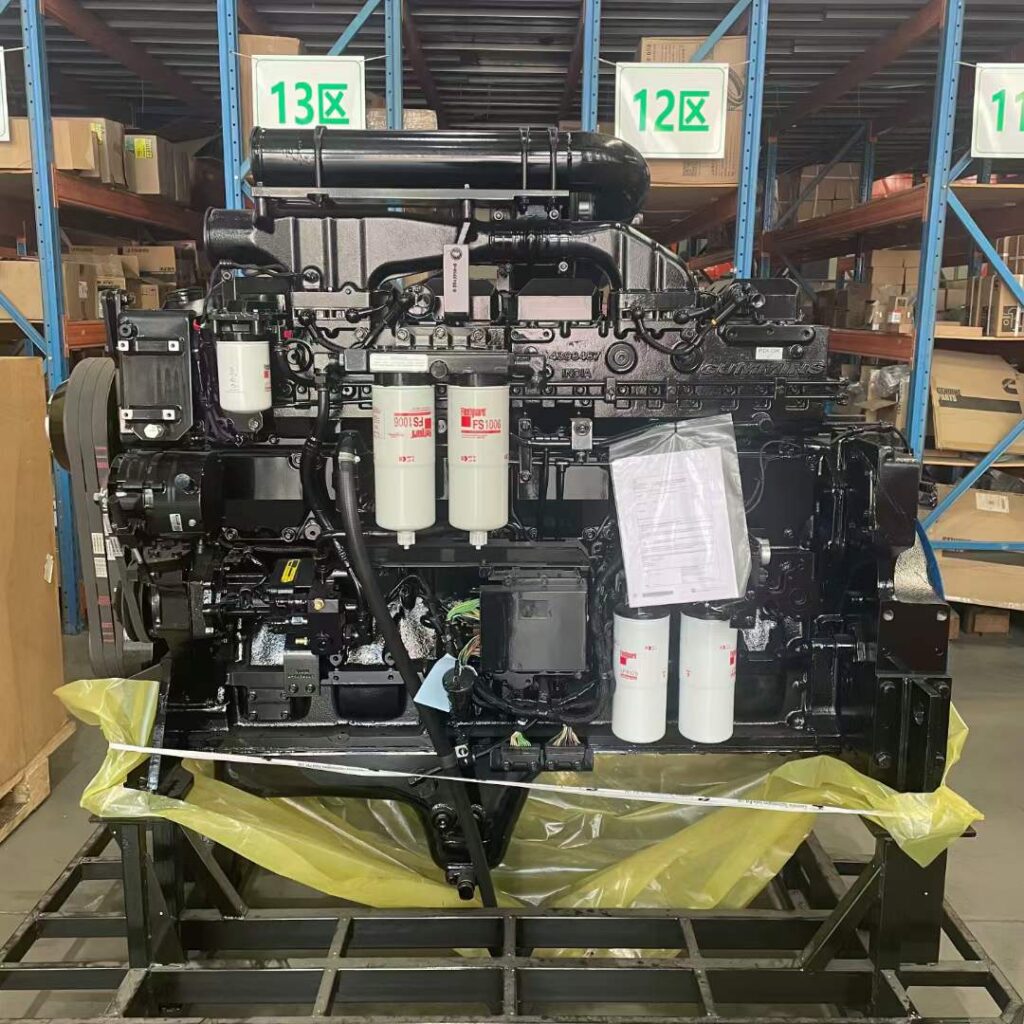
The numbers, side by side
Parameter | SAA6D170E-5 (PC1250-8, factory) | QSK23-C760 (PC1200 repower) |
Displacement | 23.15 L | 23.15 L (1,412 in³) |
Bore × stroke | 170 × 170 mm | 170 × 170 mm |
Layout | Inline-6 | Inline-6 |
Rated power | 514 kW gross (699 PS / 688 HP) @ 1800 rpm | 760 HP (567 kW) continuous @ 1800 rpm |
Peak torque | 3,205 N·m (2,364 lb·ft) @ 1300 rpm | 3,468 N·m (2,558 lb·ft) @ 1350 rpm |
Aspiration | Turbocharged, aftercooled, cooled EGR | Holset turbo + air-to-air aftercooled |
Fuel system | Electronic high-pressure common rail | HPI, full-authority electronic |
Emissions | Cooled EGR — no DPF, no SCR, no DEF | EPA Tier 2 / Euro 2 |
Oil capacity | 86 L | ~52 L |
Service interval | Extended vs. PC1250-7 (no figure given) | Oil and filter at 250 h or 6 months |
Weight | 3140 kg dry / 3200kg wet | 2,722 kg dry / 2,858 kg wet |
The power rating trap
The PC1250-8’s headline figure is 514 kW. That is gross power — ISO 14396 / SAE J1995, the engine on a stand with nothing bolted to it.
Installed, per ISO 9249 / SAE J1349, it makes 502 kW. Fan and accessories attached.
At maximum fan speed — which is what you get when the machine is hot and working, exactly when you need the power — it makes 463 kW.
That is a 51 kW spread between the brochure and the cutting edge of a working day. About 68 horsepower, roughly a small car’s entire output, gone.
The QSK23-C760 is quoted at 760 HP continuous. Continuous is the operative word; it is a rating the engine holds, not a peak you touch for three seconds. Against 463 kW net-at-max-fan, 567 kW is a real margin rather than a brochure trick.
But the two figures are not measured the same way, so they do not belong in the same column. Ask which standard a number came from. If a supplier cannot say, you are comparing a stand rating to an installed one.
Who actually decides this
On a machine this size, four people touch the decision, and they are not worried about the same thing.
The maintenance superintendent wants to know whether the job fits the bay, the tooling and the crew’s skill. A drop-in repower with identical displacement is a different conversation from one needing fabrication.
The equipment manager carries availability: how many shifts are lost, and whether that number is firm.
Procurement wants a comparable quote — a named rating standard, a scope of supply, a delivery date. Not a horsepower figure in an email.
Finance or the mine manager measures it against the real alternative, which is usually replacing or renting the machine, not repairing the engine.
If you are reading this late at night, you are probably the first or the second — in practice it is usually the equipment manager, because they are the one who takes the call when the machine is down.
These decisions stall rarely over technical disagreement. They stall because nobody wrote down what the other three need to see.
Restore or change: the fork
Everything downstream follows from one question.
Restoring — a PC1250-8 getting its intended engine back — keeps the engineering match intact. Pump curves, fan drive, the EMMS onboard monitoring system, the Economy and Power modes: all validated as a system. You are buying back something known. The cost is OEM parts economics, and in the repower case that was precisely the driver — long lead times and premium pricing on OEM parts were hurting availability before the change.
Changing — a PC1200 taking a QSK23-C760 — trades that integration for parts availability and cost. 760 HP continuous at 1800 rpm, 3,468 N·m at 1350 rpm, oil and filter at 250 hours or 6 months, and a parts network broader than a single OEM channel.
There is one hard constraint on the second path. The QSK23-C760 is EPA Tier 2 / Euro 2. In a region that has moved past Tier 2, that can be disqualifying on paper regardless of how well the engine fits.
Tier status is assessed against the machine’s serial number and the rule in force where it operates — not against the engine’s build date. A machine that was compliant when it was delivered is not automatically compliant where it works now; non-road emission tiers have been tightened in stages since these machines were built.
Check the jurisdiction before you check the price. I have seen that order reversed, and it does not end well.
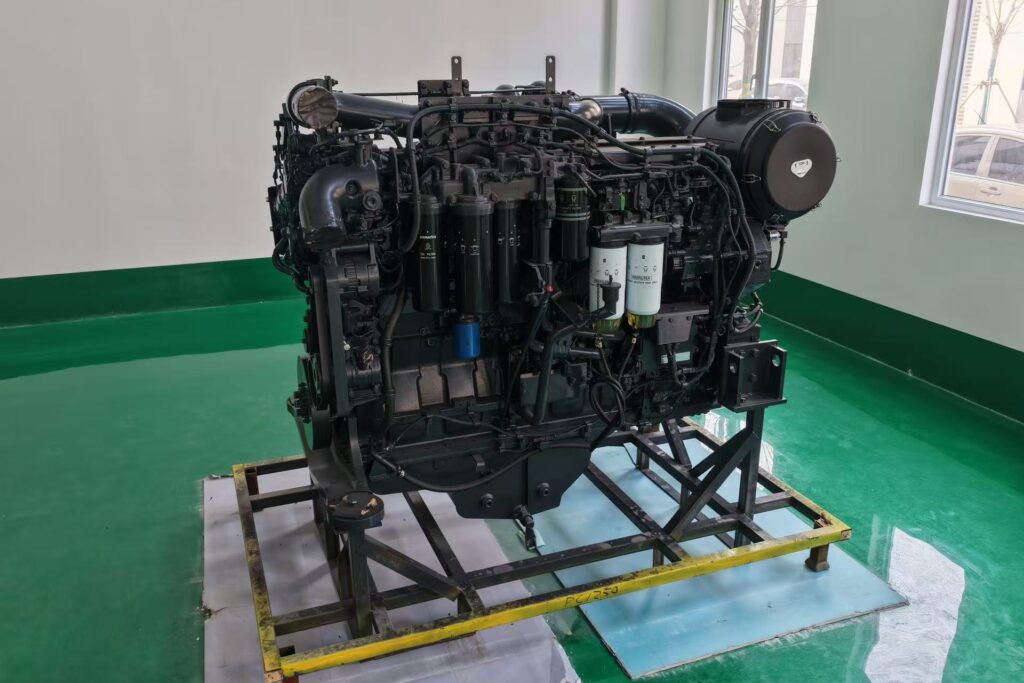
What the job looks like, in order
Seven steps, in this order, for a reason.
- Tear-down and assessment — old engine out, then inspect frame rails, slewing platform, main pump and cooling modules. Repower failures are rarely the new engine’s fault; they are the tired pump or the twice-welded frame you found on day nine with the machine in pieces.
- Engine installation — identical displacement and geometry mean the QSK23-C760 enters the existing bay. Mounting feet and isolation pads are locally adapted. That phrase is doing real work: those pads carry a roughly three-tonne mass (2,722 kg dry, 2,858 kg wet) and keep vibration out of the frame and electronics.
- Drivetrain coupling — SAE 0×18 housing to the original main pump, concentricity verified, couplings refitted.
- Cooling and intake — aftercooler and radiator re-matched, intake re-routed, dual-stage heavy-duty air filtration. More power is more heat, and mining air is full of silica. Dual-stage is baseline here, not an upgrade.
- Fuel system — HPI lines routed, filters with water separator fitted.
- Electrical and monitoring — full-authority ECM integrated with existing instrumentation over J1939, reproducing speed, coolant temperature, oil pressure and fault codes.
- Commissioning — bench test, then no-load, then loaded, then heavy-duty trial, with the pump power-absorption curve calibrated at the end.
That sequence is diagnostic. Bench test catches assembly errors, no-load catches control errors, loaded catches cooling errors, and the heavy-duty trial catches how they interact. Skip from no-load to full production and you have removed the two stages that would have told you which system to look at.
Two measurements that decide it
Everything else is fit-and-finish. These two are not.
Concentricity at step three. A coupling that is out by a little does not fail immediately. It loads the pump shaft bearing, the bearing heats, the heat becomes a seal failure three months later, and nobody traces it back to day two. Dial it. Write the number down. “It looked fine” means it was not measured.
Cleanliness at step five. The QSK23’s HPI system injects at up to 29,000 psi — roughly 2,000 bar. At that pressure a particle you cannot see is a cutting tool, and water destroys injectors. The water separator is not upsell. This step is also where schedules slip, because routing new high-pressure lines through an existing machine is fiddly work that does not photograph well.
Seven questions before you sign
- Which standard is your power figure measured under — ISO 14396, ISO 9249, or something else?
- What is the net rating at maximum fan speed? On the PC1250-8’s original engine, the gross-to-net-at-max-fan gap is 51 kW.
- Is displacement and bore-with-stroke identical to what is coming out? If not, what fabrication is required? Identical geometry is why this repower is considered low-risk.
- What is the emissions rating, and does it clear the rules where the machine will work? Get it in writing before you get a price.
- What is in scope — engine only, or mounts, cooling, intake, fuel lines, harness and ECM integration? The harness is where schedules slip.
- How is commissioning handled — does the quote include a loaded trial? Without it you are buying an engine, not a working machine.
- What is the warranty in hours and months, and who does the work when it fails? A warranty requiring you to ship the engine back is not the same as one that sends a technician.
A supplier who answers all seven crisply is a signal. One who answers five and waves at two — the two are where your problem will be.
The objections you will hear
“Repowering voids the machine warranty.” On a machine old enough to need an engine, the original warranty has almost certainly expired. Ask what the repower supplier warrants instead.
“Non-OEM hurts resale.” Sometimes true, and it cuts differently depending on whether you sell the machine or run it to the end. If you run to the end, resale is a rounding error against availability.
“OEM is safer.” Safer in what sense? If the risk you fear is a fit problem, OEM is safer. If it is waiting on a part that only one channel supplies, the answer may invert — and a single-source channel is exactly what the repower case was trying to escape. Name the risk first, then pick.
“You save 5–10% on fuel.” The case record describes that figure as representative and subject to site calibration. It is not measured against a stated baseline. If the answer is “the old engine, as it was” — remember the old engine was worn.
Who should not do this
Three cases where the better answer is a smaller invoice.
Do not replace a whole engine for a localized failure. A turbo, an injector set, a harness — those are component jobs, and on a PC1250-8 a partial repair preserves an integration you cannot repurchase. (An engine swap is also the one repair you cannot quietly undo if it turns out to be the wrong call.)
Do not repower into a region that has outlawed your emissions tier. EPA Tier 2 / Euro 2 is the QSK23-C760’s standing; check first, because this one ends the conversation.
Do not assume “drop-in” if the bay has already been modified. If a previous repair changed mounts, cooling or the pump interface, the geometry advantage is gone. Measure before you order, not after.
What to send for a real quote
Six items, about forty minutes with a phone:
- Model and serial number — the plate is on the frame. The PC1250-7 and PC1250-8 use different engines from the same 6D170 family (SAA6D170E-3 versus SAA6D170E-5), so read the plate rather than trusting the model name
- A photo of the engine nameplate, and one of the bay from the access side
- The pump interface — flywheel housing size if you can read it
- Current emissions requirement for the operating region
- What failed, and what has already been replaced
- Whether a shift schedule sets your downtime window
Send those and the comparison becomes real. Send a model number and you will get a brochure.
FAQ
Which engine fits a Komatsu PC1250? A PC1250-8 was built around the Komatsu SAA6D170E-5 — 23.15 L inline-six, 170 × 170 mm, 514 kW gross at 1800 rpm. Confirm your dash number first; -7 and -8 differ.
Which engine fits a Komatsu PC1200? The Cummins QSK23-C760 is a documented repower for this class, sharing the original’s 23.15 L displacement and 170 × 170 mm bore and stroke, with an SAE 0×18 flywheel housing.
Does the repower need fabrication? Mounting feet and isolation pads were locally adapted in the documented repower. The major interfaces — displacement, layout, flywheel housing — carry over.
What does the QSK23-C760 make? The QSK23-C760 makes 760 HP (567 kW) continuous at 1800 rpm, with 3,468 N·m (2,558 lb-ft) of peak torque at 1350 rpm. Confirm whether your quote cites the continuous rating or a peak rating.
Can I keep my existing monitoring? The repower integrated the QSK23’s full-authority ECM with the machine’s instrumentation over J1939, reproducing speed, coolant temperature, oil pressure and fault codes.
How long does the job take? Neither case record gives a duration, and quoting one would be invention. Ask for the shop’s step-by-step schedule and check that steps four through seven are in it.